
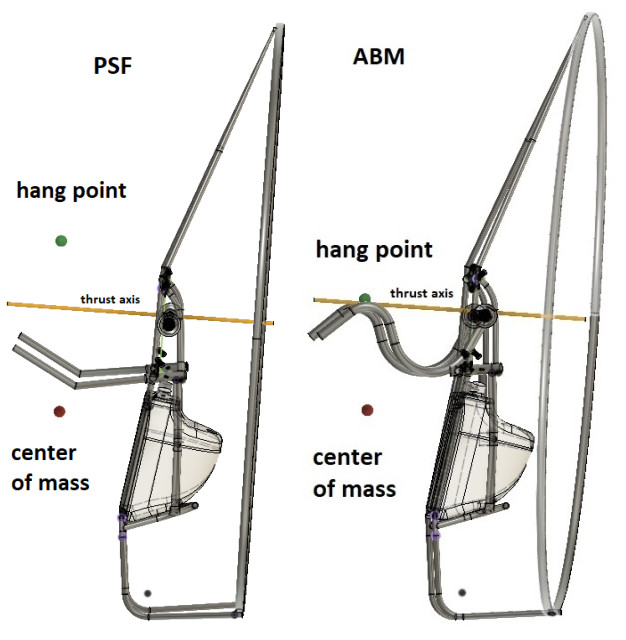
PSF vs ABM – two attachment systems, both invented by Miniplane
The way a Miniplane harness works depends on where the wing is attached and on the shape of the arms. We offer two solutions, both of which we proudly created.
PSF
ABM
Wing attachment
About at the pilot’s eye level, 40–45 cm above the centre of gravity
Closer to the centre of gravity
Arms
Two fixed spacer arms
S-shaped pivoting arms (“goose neck”, “swing arms”)
Feel in flight
Very stable, damps turbulence
Responsive and dynamic, yet stable
Ideal for
Schools, pilots who want maximum stability
Pilots who want active control, ex free-flight pilots
PSF – our first original solution
With PSF, the wing is attached roughly at the pilot’s eye level. Two fixed spacer arms under the pilot’s arms keep the harness in the correct position in every phase of flight.
This drastically reduces the destabilising effect of propeller torque, keeps paramotor, pilot and wing perfectly aligned, prevents oscillations and absorbs turbulence. Because the attachment point is 40–45 cm above the centre of gravity of the whole system (pilot included), stability is remarkable.
PSF was developed when paramotor pilots flew standard free-flight wings; with these wings, the brake handles need a different length adjustment. Many schools and pilots still choose it for its practicality and reassuring stability – and it has also won competitions where great handling was required.
ABM – responsive, yet stable
Pilots coming from free flight are used to very reactive wings that call for quick, dynamic input. For them we created ABM.
The attachment point sits closer to the centre of gravity and is not rigidly fixed to the frame, so the pilot can shift weight sideways more freely. The key innovation is the S shape of the arm: it aligns the propeller axis (the centre of thrust), the wing attachment (the point of resistance) and the pivot of the arms.
The result is a neutral paramotor: highly responsive to the pilot’s input, yet with good intrinsic stability and comfort. Manoeuvrability is often mistaken for instability – ABM shows they are not the same thing.
About the names: PSF comes from the Venetian “Par Sentarse Fàçile” – “easy seating” – because easy seating after take-off was a major concern for beginners at the time. ABM stands for “A Braccetti Mobili” (pivoting arms) and also “A Braccetti Medi” (medium-length arms): both are true.